Bahasa Indonesia
 English

UNY Strengthens the Capacity of Indonesian School Teachers in the Middle East through Ethno-STE(A)M Teaching Material Innovation
Primary tabs
Submitted by admin on Tue, 2026-08-18 21:04
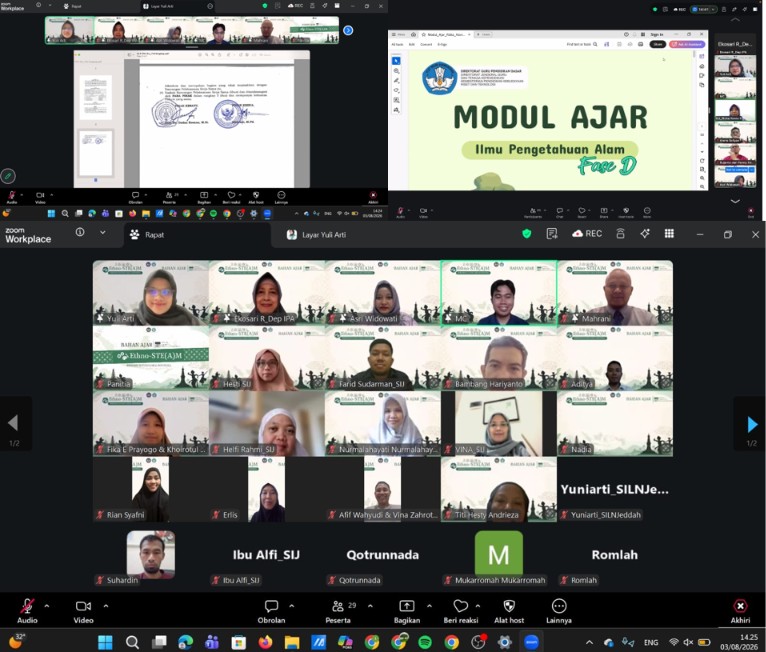
Universitas Negeri Yogyakarta (UNY), through its community service program, continues to support efforts to improve the quality of Indonesian education abroad. One such initiative is the program entitled “Strengthening the Competence of Indonesian School Teachers in the Middle East through Training on the Development of Ethno-STE(A)M Teaching Materials Based on Indonesia’s Local Potential.” The program aims to support the achievement of SDG 4: Quality Education. The program was initiated in response to the need for teachers at Indonesian Schools in the Middle East to develop teaching materials that are not only aligned with the curriculum but also incorporate Indonesian cultural contexts and local potential. Contextual learning is considered important in helping Indonesian students living in multicultural environments remain connected to their national identity and the richness of their homeland.
The program was led by Prof. Dr. Asri Widowati, S.Pd.Si., M.Pd., together with Ir. Ekosari Roektiningroem, M.P., Yuli Arti, M.Pd., and student team members Ahmad Atabik Adlysyah, Dian Candra Aditya, and Hanan Nur Nabil. The program was implemented through socialization, training, teaching material development practice, technology application, mentoring, and evaluation. The approach was participatory, collaborative, and product-oriented. Through this approach, teachers not only gained knowledge but also produced teaching materials that could be directly implemented in their classrooms. A key stage of the program was the online training conducted on 3 and 18 August 2026, involving 38 teachers. The training covered the fundamental concepts of Ethno-STE(A)M, the integration of local potential into learning, the development of innovative teaching materials, the design of projects based on local culture, and strategies for implementing these approaches in Indonesian Schools abroad.
Ethno-STE(A)M guides teachers in connecting science, technology, engineering, arts, and mathematics with cultural potential, the environment, traditions, technology, local food, energy, and sustainability. In this way, Indonesia’s rich heritage can become a meaningful learning resource for students, even when they are studying far from their homeland. The training did not stop at theoretical discussions. Participants directly practiced developing teaching materials through a Learning Management System (LMS). They used a teaching material template that incorporated local potential contexts, guiding questions, STE(A)M activities, investigations or experiments, projects, authentic assessments, reflection, and the integration of Sustainable Development Goals.
The program achieved encouraging results. During the technology application stage, all participants successfully developed initial drafts of digital Ethno-STE(A)M teaching materials tailored to their respective subjects and educational levels. These products were further developed through online consultations, group discussions, and peer reviews. The mentoring process helped participants improve various aspects of their teaching materials, including refining learning objectives, strengthening the integration of local culture, improving project-based activities, enhancing authentic assessment, and increasing the quality of the digital teaching material design. This process not only resulted in learning products but also provided valuable professional learning experiences for the teachers.
The program will continue beyond the completion of the training. The teaching materials developed by participants will be further refined through feedback and review from the team before being implemented in learning activities at Indonesian Schools in the Middle East. This process will provide a basis for documenting good practices, student responses, implementation challenges, and the effectiveness of the teaching materials. The collaboration between the university and Indonesian Schools in the Middle East is expected to develop into a long-term partnership through academic mentoring, further training, and the development of research and community service initiatives. Thus, Ethno-STE(A)M innovation is expected not only to serve as a training activity but also to evolve into a sustainable model for teachers’ professional development.
Kontak Kami
Program Studi Pendidikan IPA
FMIPA Universitas Negeri Yogyakarta
Kampus Karangmalang Yogyakarta 55281
Email: s1pend_ipa@uny.ac.id
Instagram: @depdikipauny