Bahasa Indonesia
 English

In Support of SDG 4, Science Education Programme Students Implement the ‘Snakes and Ladders’ TGT Learning Model at SMPN 2 Bantul
Primary tabs
Submitted by admin on Tue, 2026-09-15 15:13
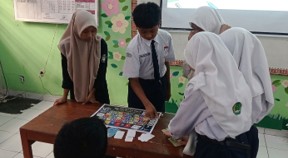
Zain Nurhanifah and Ferninda Khoiruni, Education Practice (PK) students on the Science Education programme, introduced an innovative teaching approach at Bantul State Secondary School No. 2 as part of a collaborative effort to achieve Sustainable Development Goal (SDG) 4: Quality Education. From 31 August to 4 September 2026, they adapted the topic ‘Matter and Its Changes’ for Year 7 pupils—a subject previously considered abstract—using the Teams Games Tournament (TGT) learning model based on a snakes and ladders game.
Based on the observations carried out, the teaching methods currently in place at the school have not yet optimally implemented a student-centred approach and rely on practice questions in modules completed independently. This situation has led to some pupils being less actively engaged in learning and less motivated to practise understanding the concepts. To address this issue, the PK students designed a snakes and ladders game board as a medium for group competition, complete with question cards of varying difficulty levels: easy, medium and hard. In addition, there were bonus, challenge and crisis cards included in the ‘Snakes and Ladders’ game sheet on the topic of Substances and Their Changes.
Throughout the activity, the classroom atmosphere was lively and interactive. Each group took turns rolling the dice and moving their pieces along the snakes and ladders board; whenever they landed on a square, the pupils had to pick up and answer a question card according to the predetermined level of difficulty. The pupils appeared enthusiastic and encouraged one another within their groups, particularly when their pieces landed on the ‘bonus, challenge and crisis’ squares – where they found excitement and challenges in every move – as well as when they had to answer difficult question cards to maintain their position. The group-based competition system in this TGT approach also encouraged pupils to discuss amongst themselves to ensure the correct answers before submitting them to the tournament table.
The implementation of this game-based TGT learning model has proven to spark a very high level of enthusiasm for learning amongst the pupils. The fun, competitive atmosphere ensures that pupils do not feel overwhelmed, even whilst working on science questions of gradually increasing difficulty. One Year 7 pupil shared his impressions of taking part in the learning activity through the snakes and ladders game: “It’s really exciting, so I don’t get bored. I’ve also come to understand the material better. If possible, I’d love to play a game like this again tomorrow,” said Fadhil, a Year 7 pupil at 2 Bantul State Junior High School.
This teaching practice, initiated by Science Education PK students in collaboration with 2 Bantul State Junior High School, is a tangible demonstration of the education sector’s commitment to supporting the achievement of the SDGs. The use of the TGT model, based on the ‘Snakes and Ladders’ game, not only creates a fun and healthily competitive learning environment, but also helps students grasp scientific concepts in an engaging way, whilst fostering teamwork from secondary school age onwards.
Kontak Kami
Program Studi Pendidikan IPA
FMIPA Universitas Negeri Yogyakarta
Kampus Karangmalang Yogyakarta 55281
Email: s1pend_ipa@uny.ac.id
Instagram: @depdikipauny