Bahasa Indonesia
 English

Science Education Lecturer from FMIPA UNY Shares Strategies for AI-Enhanced OBE Learning Design at FKIP UMC
Primary tabs
Submitted by admin on Wed, 2026-09-16 10:48
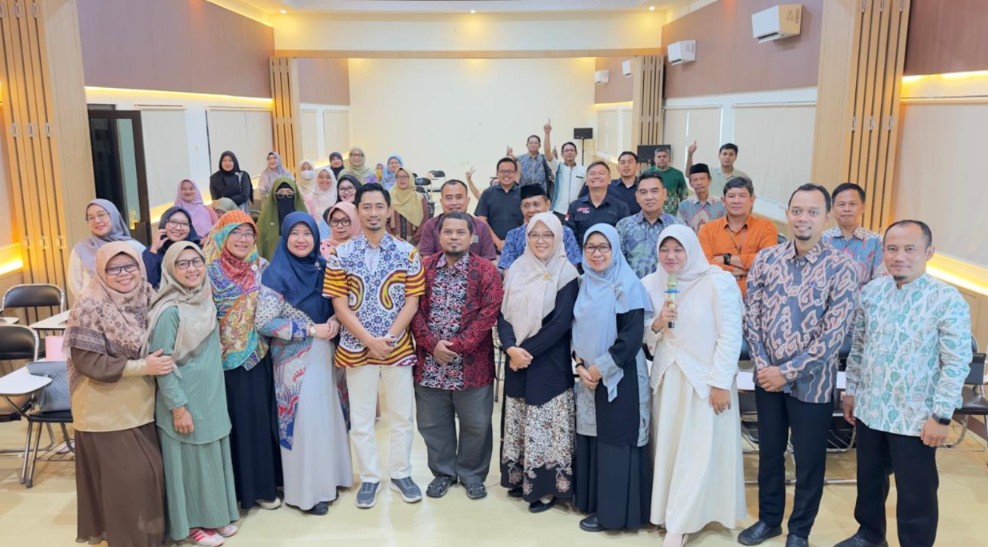
Dr. Sabar Nurohman, M.Pd., a lecturer in Science Education at the Faculty of Mathematics and Natural Sciences (FMIPA), Universitas Negeri Yogyakarta (UNY), served as a speaker at an In-House Training (IHT) organized by the Faculty of Teacher Training and Education, Universitas Muhammadiyah Cirebon (FKIP UMC), on Saturday, September 12, 2026. Held at the FKIP UMC Campus 2 Ballroom, the training focused on “AI-Enhanced Learning Design in OBE-Based Education: From Outcome Planning to Evidence of Learning.” The half-day training was attended by approximately 70 FKIP UMC lecturers and officially opened by the Dean of FKIP UMC, Dr. Hj. Fikriyah, M.A. Dr. Sabar’s involvement as a speaker provided an opportunity to share insights and practices in developing Outcome-Based Education (OBE) learning that responds to the rapid development of Artificial Intelligence (AI) technologies.
In his presentation, Dr. Sabar encouraged participants to view AI not merely as a tool for generating learning materials or presentations, but as an instructional design partner that can support a more systematic learning design process. AI can assist lecturers in mapping Program Learning Outcomes (CPL), Course Learning Outcomes (CPMK), and Sub-CPMK, developing learning activities, formulating achievement indicators, designing assessments and rubrics, and checking the alignment among learning outcomes, learning activities, and assessments. One of the key concepts highlighted during the session was constructive alignment, which emphasizes the connection among learning outcomes, student learning activities, and assessment. Within OBE implementation, these three components need to be designed as an integrated system so that learning activities and assessments provide meaningful evidence of the intended learning outcomes. In this context, AI serves as a supporting instrument to help lecturers develop more relevant and systematic learning designs.
Dr. Sabar also introduced participants to various AI platforms and their potential applications in education. ChatGPT and Gemini, for example, can support the development of case-based learning, problem-based learning (PBL) scenarios, Socratic questions, question variations, rubrics, and learning feedback. Meanwhile, NotebookLM was introduced as a source-based AI tool that enables lecturers and students to explore books, articles, modules, guidelines, and other learning documents through various modes, including summaries, Audio Overview, study guides, and other multimodal learning resources. In addition to AI platforms, participants discussed the use of learning technologies such as Canva, Mentimeter, Google Forms, Quizizz, Kahoot, and Learning Management Systems (LMS) to create more participatory learning experiences. These technologies can support active learning, flipped classrooms, formative assessment, immediate feedback, and the use of learning data to inform subsequent improvements in teaching and learning.
The training was conducted interactively through brainstorming activities, Mentimeter polling, discussions, reflections on participants’ experiences with AI, and discussions of examples of AI applications in learning design. These activities enabled participants to connect the concepts presented during the session with the practical needs of the courses they teach. Ethics and academic integrity in AI use were also emphasized. The use of AI needs to be accompanied by expert review, source verification, personal data protection, attention to potential bias and hallucination, respect for copyright, and transparency in its use. Therefore, strengthening AI literacy is essential to ensure that AI can be integrated responsibly into educational practices.
For Dr. Sabar, the forum also served as an opportunity to expand academic networks and share experiences regarding the transformation of higher education learning. The interaction with FKIP UMC lecturers provided a valuable space to discuss how OBE principles can be translated into meaningful student learning experiences supported by rapidly evolving technologies. Through this activity, AI was positioned not as a replacement for lecturers, but as a technology that can strengthen lecturers’ capacity to design outcome-oriented, student-centered, adaptive learning experiences supported by measurable evidence of learning. The activity also represents the contribution of Science Education lecturers at FMIPA UNY in sharing knowledge and good practices in learning innovation with partner higher education institutions.
Kontak Kami
Program Studi Pendidikan IPA
FMIPA Universitas Negeri Yogyakarta
Kampus Karangmalang Yogyakarta 55281
Email: s1pend_ipa@uny.ac.id
Instagram: @depdikipauny