Bahasa Indonesia
 English

Science Education Students Introduce Pupils to Thermal Expansion through the Design of Safe Infrastructure at 1 Tempel State Secondary School
Primary tabs
Submitted by admin on Wed, 2026-09-16 11:03
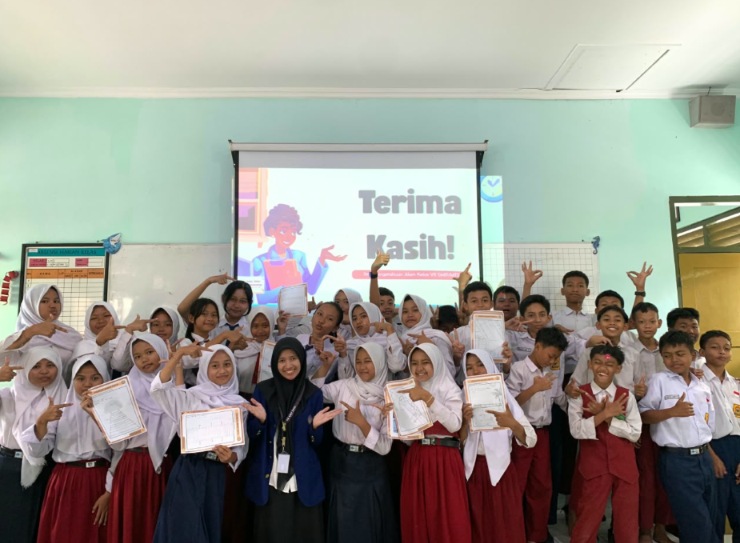
A science lesson on the concept of expansion was delivered by Veninda Fitriana Kusumawardhani, a student on a teaching placement at SMP Negeri 1 Tempel, on Monday, 7 September 2026, from 12.55 to 14.15. The session involved pupils from Class VII D as part of a science curriculum that links scientific concepts to their application in everyday life. This activity also supports the Sustainable Development Goals (SDGs), specifically SDG 4 (Quality Education), SDG 9 (Industry, Innovation and Infrastructure), and SDG 11 (Sustainable Cities and Communities). This connection is evident through the learning process, which encourages the application of scientific concepts in designing infrastructure that is safe and appropriate to environmental conditions.
The activity aims to help pupils understand the application of the concept of thermal expansion in everyday life. The lesson begins with a discussion of the definition of thermal expansion and the types of expansion in solids, liquids and gases. Pupils then observe examples of thermal expansion in various infrastructure, such as the gaps in railway track joints and specific parts of bridge structures. Afterwards, the pupils were divided into several groups to design a bridge or railway track, taking into account the parts that require space for thermal expansion due to temperature changes. Each group illustrated their design and provided an explanation of how the concept of thermal expansion had been applied. Student teachers facilitated the discussion, provided guidance, and helped the pupils link their designs to the science concepts they had learnt.
The activity involved producing various designs for bridges and railway tracks that took into account dimensional changes caused by temperature fluctuations. Through this activity, pupils gained experience in applying the concept of thermal expansion to solve real-world problems. Pupils also practised analysing problems, identifying solutions, working collaboratively in groups, and communicating their design outcomes. This activity supports SDG 4 (Quality Education) through active, contextual learning that encourages pupils to apply their knowledge in real-life situations. It also supports SDG 9 (Industry, Innovation and Infrastructure) as pupils are introduced to the importance of applying scientific concepts in designing infrastructure that is safe, functional and capable of adapting to changing environmental conditions. Furthermore, the activity relates to SDG 11 (Sustainable Cities and Communities) by introducing the principles of infrastructure safety and sustainability, which can support the creation of safer and more comfortable living environments.
It is hoped that this activity will help pupils understand that science concepts can be applied to solve problems in everyday life. The experience of designing infrastructure based on the concept of thermal expansion is expected to develop pupils’ critical, creative and problem-solving skills. Similar activities can also be developed through other science learning projects that link scientific concepts to issues in the local environment.
Kontak Kami
Program Studi Pendidikan IPA
FMIPA Universitas Negeri Yogyakarta
Kampus Karangmalang Yogyakarta 55281
Email: s1pend_ipa@uny.ac.id
Instagram: @depdikipauny