Bahasa Indonesia
 English

Technology-Based Transformation of Science Learning: Integrating Canva, Educational Games, and Barcode-Enabled Bulletin Boards to Support Quality Education
Primary tabs
Submitted by admin on Mon, 2026-09-21 11:48
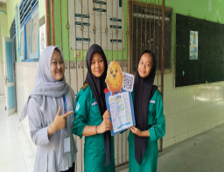
Science learning at SMP Negeri 2 Sleman has become more interactive and engaging through the implementation of creative, technology-based learning approaches focusing on measurement and the introduction to cells. These activities were conducted throughout September and actively involved seventh- and eighth-grade students. They also represented one of the contributions of Maulina Jazhilatul Khikmiah, a Science Education student participating in the Educational Practice (Praktik Kependidikan/PK) program at Universitas Negeri Yogyakarta (UNY), to supporting Sustainable Development Goal (SDG) 4: Quality Education.
For the topic of measurement, which was taught throughout September, students were invited to learn how to measure various quantities and identify appropriate units through an interactive educational game entitled “Petualang Si Pengukur” (The Measurement Explorer). The game was designed using Canva AI, featuring an engaging interface that students could access directly through their own mobile devices without installing any additional applications. Through the game, students completed a series of measurement missions, ranging from identifying instruments for measuring length, mass, and time to practicing how to determine the appropriate unit for each measured quantity.
Each mission in the game was designed progressively, allowing students to review measurement concepts independently whenever necessary while also assessing their understanding in a more enjoyable way than conventional learning methods that rely primarily on textbooks. This digital game-based approach generated greater enthusiasm and active participation among students in learning measurement concepts, which are fundamental science concepts that some students may otherwise perceive as less engaging.
For the introduction to cells, which was also conducted throughout September, learning was presented through an informative and visually engaging bulletin board entitled “Cells.” The bulletin board was designed to be attractive, informative, and easy for eighth-grade students to understand. It presented a summary of key concepts, including the definition of cells, types of cells, the structures of eukaryotic animal and plant cells, cell organelles and their functions, and life processes within cells. The concepts were accompanied by colorful illustrations to help students understand and remember the material more easily.
A distinctive feature of this bulletin board was the inclusion of a barcode that students could scan to access the educational game “Cell Kingdom: The Organelle Quest.” Through the game, students were invited to explore the world of cells interactively, beginning with learning how to use a microscope and identifying cell organelles and their functions through activities such as pointing to organelles or completing description fields. Students also explored the differences between animal and plant cells and learned about the levels of biological organization. The combination of the infographic bulletin board and barcode-enabled educational game generated greater enthusiasm for learning cell concepts, which are often considered abstract and difficult to visualize. At the same time, the approach encouraged students to learn independently and review the material whenever needed simply by scanning the available barcode.
These learning innovations implemented throughout September demonstrate how technology, particularly Canva AI, can create more active, creative, and meaningful science learning experiences for students. The use of interactive educational games and barcode-enabled infographic bulletin boards not only helped students develop a better understanding of scientific concepts but also encouraged independent learning and increased their interest in science. The activities are aligned with SDG 4: Quality Education, as Science Education students participating in the UNY Educational Practice program sought to introduce innovative learning processes at SMP Negeri 2 Sleman that are relevant to technological developments and capable of encouraging students to actively engage in understanding science concepts comprehensively.
Kontak Kami
Program Studi Pendidikan IPA
FMIPA Universitas Negeri Yogyakarta
Kampus Karangmalang Yogyakarta 55281
Email: s1pend_ipa@uny.ac.id
Instagram: @depdikipauny